Custom Banjo Options
Every banjo I build has its own personality. Some folks know exactly what they want, while others just know the sound, look, or feel they’re after.
The photos and examples below will give you a feel for the options available. If we end up building one together, I’ll help guide you through the choices.
I’m always glad to help you sort through these options or answer any questions.
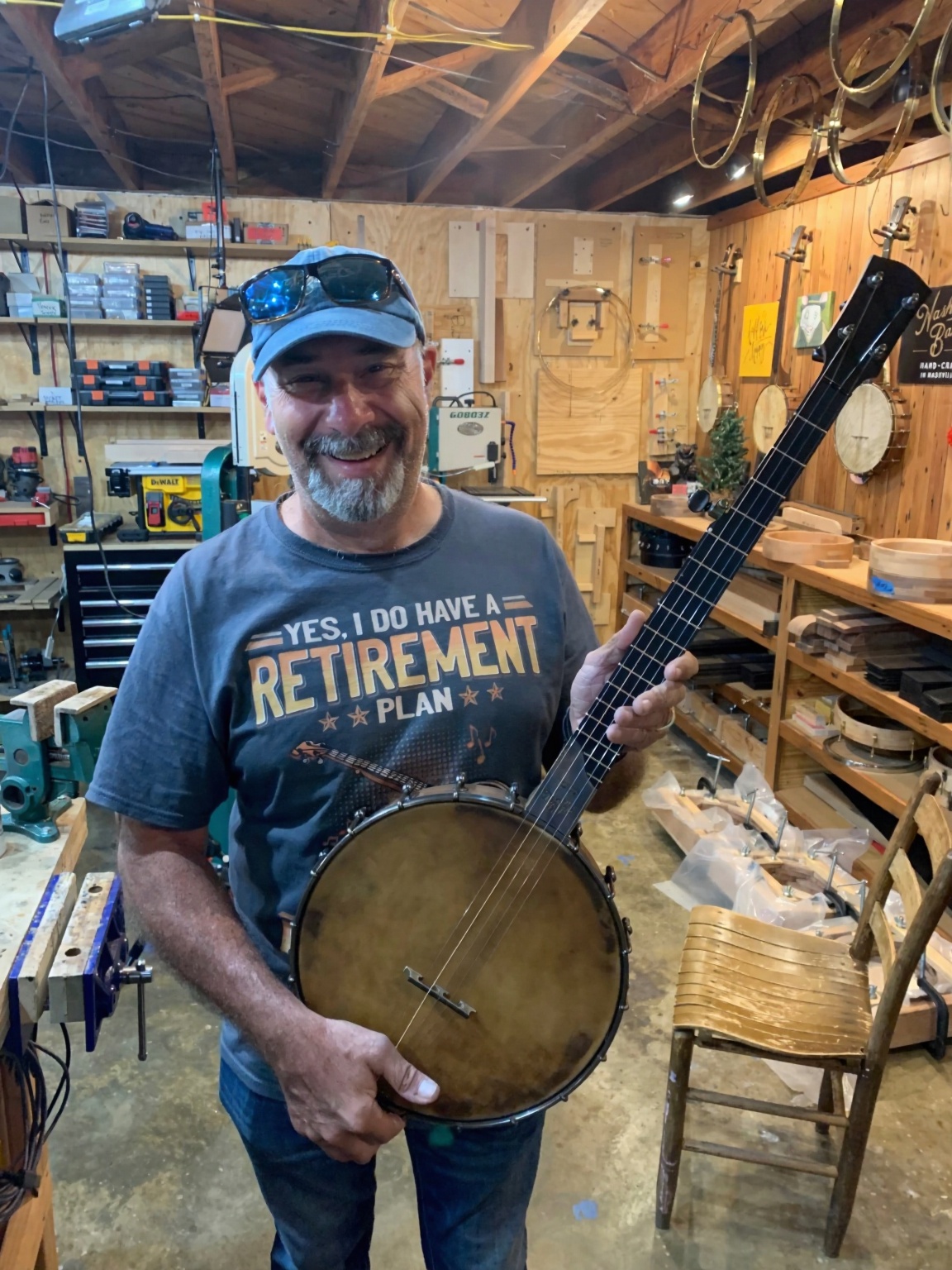
Every banjo has a story, – let’s start yours.
Neck & Rim Wood
Most folks choose either Walnut or Cherry for their banjo neck and rim. Both are dense hardwoods that make clear, great-sounding instruments. Walnut is the most popular — naturally dark, with a tone that leans towards warm and clear. Cherry is lighter in color, with a tone that’s a touch rounder and more mellow. The tonal difference is very subtle, and the choice is usually made based upon the look you’re drawn to.
From time to time I have premium figured stock available. I also enjoy building heirloom banjos from wood that has a story — maybe it came from your grandmother’s house or your family farm. Choosing the wood is one of the most enjoyable parts of the whole process, and I’m always happy to help you find the look and tone that feels right for your instrument.
Natural heads & Skins
Most of the banjos I build use a natural goatskin head. Not everyone comes in knowing they want one — but once folks see the look, hear the tone, and understand the history behind them, it’s usually the direction they choose.
If you’re able to visit the shop, picking out the head is often the best part. We spread out dozens of skins on the bench and look for the one that speaks to you. Some are clean and light, others dark and wildly textured. Everyone gravitates toward something different, and there’s always that “aha” moment when the right one shows up.
If you can’t be here in person, we simply do it by text or email. You tell me the vibe you’re after — clean, bold, weathered, or anything in between — and I’ll send plenty of options until we land on the perfect fit. And if you love a vintage, broken-in look, I can dye the skin in strong coffee to coax out more color and character.
Tonally, natural skin has a warmth and honesty that plastic heads can’t really match. Notes on a skin head tend to crawl off the banjo — breathy, thumpy, and old-timey. On a synthetic head, notes more often bounce or ping — brighter and more modern. Skin heads were the standard until the 1950s, and they still produce the wonderfully woody tone so many players love today. They’re more sensitive to humidity, but most folks find the improved tone far outweighs the extra bit of care.
Hardware & Tuners
Every Nashville Banjo Co. instrument is built with North American–made brass hardware — durable, musical, and a perfect fit for an open-back banjo.
The standard setup uses classic 2-point brass-plated shoes with matching nuts. An upgrade to solid brass hardware gives you more style options — different shoe shapes, nut designs, and small visual details that help your banjo feel more personal. Solid brass also develops a gentle patina over the years, adding warmth and character as the instrument ages.
Standard builds come with smooth, dependable Gotoh planetary tuners, or you can upgrade to the premium Rickard Cyclone high-ratio tuners if you prefer tuning to be as precise as it gets.
If you love the character of older instruments, I can also hand-antique the brass right here in the workshop. This is one of the most distinctive features of my builds —rich, warm patina that looks a hundred years old but feels brand new. The aged brass pairs beautifully with walnut and cherry, and it gives the whole banjo a timeless presence the moment you pick it up.
neck shape & feel
The neck is where your hand lives, so getting the feel right is an important detail. Every neck is hand-carved, one at a time, shaped until it sits naturally in the palm.
My most popular neck profile is a soft semi-V — comfortable, quick to move around on, and reminiscent of the feel of a well-played vintage instrument. Some folks prefer a smooth C-shape, similar to a guitar neck, while others like the crisp ridge of a more defined V profile. All three shapes work beautifully; it just depends on what feels best in your hand.
My standard neck width is 1-5/16 inches at nut, a sweet spot that gives your fingers room without feeling oversized. But if you prefer a wider or narrower neck, we can make that happen.
The heel (where the neck meets the rim) offers another chance to shape the character of your banjo. The classic style is a vintage heel with an ebony heel cap — clean, elegant, and traditional. A Dobson-style heel, more rounded and “folk” in appearance, adds a touch of old-time charm and pairs especially well with the 13″ Governor model.
One of the small touches I love adding is the gentle hand-carving around the fifth-string peg — flowing curves that lead your eye down the neck. It’s subtle, completely optional, but a distinctive Nashville Banjo Company hallmark.
Whether you know exactly what you want or you just know what feels good in your hand, we’ll find a neck that fits you like an old friend.
fretless options
Choosing between a fretted and fretless banjo is one of the most defining decisions in the whole build — not better or worse, just two different ways of speaking through the instrument.
A fretted banjo gives you clean intonation, quick accuracy, and the ability to jump into any jam with confidence. If you’re new to banjo this is usually the best starting point. Most of the banjos I build are fretted, and for good reason — they’re versatile, dependable, and easy to fall in love with.
A fretless banjo has a voice all its own. Paired with gut strings, the sound becomes ancient and wonderfully expressive — the kind of tone that makes you slow down, feel every slide and taste every note. Some folks start here, but most start with a fretted banjo and eventually join the journey to explore what fretless offers.
I also offer half-fretless and flush-fret options. Flush frets give you visual reference lines (you see the “fret,” but feel nothing under your fingers), making fretless playing more approachable without losing its character. It’s still entirely ear-driven — just with a little extra confidence built in. Half-fretless models have a smooth brass plate up through the 7th fret, then switch to regular frets. This lets you slide and sway in the lower positions and still have clean fretted clarity when you reach for those high notes.
Scoop design
The scoop — the small carved-out section between the fingerboard and the rim — is both a practical feature and a great place to add a personal touch to your banjo. It gives clawhammer players room to play over the neck, where the tone gets round and warm, and it’s one of my favorite parts of the instrument to customize.
My most popular option is a brass scoop engraved with the Nashville Banjo Co. logo and personalized with your name. Some folks prefer a logo-only scoop with no name, while others may choose to engrave custom artwork or text. Any brass scoop can be gently antiqued to match the rest of the hardware.
A custom inlay on an ebony scoop is one of the most beautiful and personal touches you can add to your banjo — carved right into the fingerboard, it gives the instrument its own quiet signature. And if simple feels best to you, a plain ebony scoop without inlay is still a classic, time-tested option.
Peghead Inlays
The peghead is often the first thing someone notices — it’s the banjo’s handshake. A simple ebony peghead makes a crisp statement, especially when paired with an ebony fingerboard and a black buffalo-horn nut. That sleek, uninterrupted line of black running all the way down the neck has become one of the quiet little signatures of the banjos I build.
But for most builds, a custom peghead inlay is where the banjo really starts to show its personality. One of the most popular choices is the Nashville Banjo Company logo in gold mother-of-pearl, which pairs beautifully with brass hardware. It’s a clean, classic mark that feels right at home.
If you want something a little more personal, that’s where things get fun. I’ll work with brass, copper, or mother-of-pearl to create a design that’s uniquely yours. Sometimes someone sees an inlay I’ve done before and says, “Yep, that’s it.” Other times, we dream it up together — you bring a sketch, a story, or even just a feeling, and I help shape it into an inlay that fits the instrument and means something to you every time you pick it up.
RIM optionS
I build all of my rims using solid block construction from North American hardwoods — strong, stable, and full of character. You can choose from 11-inch, 12-inch, or 13-inch rims depending on the voice and feel you’re after.
Most of my banjos use an integral wood tone ring, where the top of the rim is shaped to create the tone-producing edge. It’s a warm, lively setup with plenty of energy — more plunk than plink, and a big part of the Nashville Banjo Company sound.
If you prefer the voice of a metal tone ring, I’m happy to build that too. A rolled brass hoop or Dobson-style ring can bring a bit more sparkle and bite to the top-end while still blending beautifully with an open-back banjo. Some players know exactly what they want here, while others simply lean on my recommendation — both approaches work.
For players who love a more refined look, an ebony rim cap is a very popular upgrade. It adds a clean line of black around the base of the banjo and ties in beautifully with an ebony fingerboard or peghead. It doesn’t change the tone — just sharpens the whole aesthetic in a way a lot of folks really enjoy.
fingerboard
I use ebony for all of my fingerboards — it’s strong, stable, and has that classic look that just feels right on an open-back banjo.
Most builds use a 25½-inch scale, but the 11” Broadway model can also be made in a 23½-inch short scale. Short-scale necks are incredibly comfortable to play, and they let you tune up to standard A or Double-D without a capo to help keep those fiddle players happy.
For fret markers, you can keep things clean with no dots at all (my personal favorite — just a sleek stretch of ebony), or add brass, copper, or mosaic dots in a few tasteful styles. A small inlay at a key fret, like the 12th, can also be a beautiful touch. Whatever direction we go, I’ll help make sure it fits the look and personality of the banjo. Whether we leave the face clean or not, I usually install brass side dots along the edge of the fingerboard so you can see where you are at a glance.
Finish
A banjo’s finish shapes not only how it looks, but how it feels in your hands. I offer a few different approaches, each bringing out a different side of the wood.
A natural beeswax finish brings dark woods like walnut to life with a soft, natural glow. You can feel the wood under your hand — warm, smooth, and organic. While it may need an occasional touch-up with some wax I provide you with, most players enjoy that little bit of care.
The rim is almost always finished in a hand-rubbed satin poly — it holds up beautifully around all the hardware — and many players choose this for the entire neck as well. It’s low-maintenance, durable, and has a clean, understated look that still lets looks and the feel the wood’s natural grain show through.
For something with a definite old-soul character, I also offer an ebonized distressed finish. Cherry or walnut is darkened using an old iron-acetate process, then lightly relief-sanded and top-coated. The result is a rich, vintage look that feels like a well-loved instrument from a century ago.
OTHER OPTIONS
In addition to all the options listed above, a custom banjo has plenty of small choices that help it fit your hands, your style, and the way you make music. Here are a few of the more common:
Left-Handed Builds
Every option you see on this page can be built for left-handed players. I’ve built many of them over the years, and the process is the same — just flipped. If you play lefty, you’re fully covered.
String Choices
Most players use phosphor-bronze steel strings for a clear, lively voice. If you prefer a warmer, older sound, I can string your banjo with Nylgut strings, which pair beautifully with fretless or half-fretless builds.
Spikes for the 5th String
Railroad spikes at the 7th fret (and sometimes the 9th) make it easy to change keys without a lot of fuss. It’s a simple addition and one most players appreciate.
Pickups
If you gig or just want the option to plug in and treat the neighbors, I can install a linear transducer pickup designed especially for open-back banjos. The tone is exceptional and sounds very acoustic. With the jack mounted cleanly on the rim, it’s discreet, reliable, and keeps the banjo’s acoustic voice intact.
Synthetic Heads
While most folks go with goatskin, I’m happy to build with a synthetic head for players who want something ultra-stable and weather-resistant. Fiberskyn and Renaissance-style heads are both great options.
Decorative Overlays
For something a little different, the peghead and heel cap can be trimmed in figured hardwood overlays (like burled walnut) or even solid brass instead of ebony. It adds a true “custom” look and feel and looks especially sharp on heirloom-style builds.
And More
If you have an idea you don’t see listed, feel free to ask. Every banjo starts with a conversation, and part of the fun is shaping the instrument to suit your playing and your personality.
Let’s Talk
Whether you’re ready to start a build, want to talk through ideas, or just have a few questions, I’m here and happy to help.